Category: Economy

  • Strong towns are built on many small businesses

    Strong towns are built on many small businesses

    If you’d rather listen to this article, use this audio player. (5 mins)


    Here are some insights from a conversation with one of our local restaurant owners. Their experiences highlight the challenges faced by our downtown’s small businesses.

    Inspired by the principles of Strong Towns and the economic success of startups and nations that have risen from poverty, we’d like to advocate for our small business owners in a way that fosters collaboration and growth.

    We’re encouraged by the initiatives already in motion to strengthen our downtown, such as addressing vacant storefronts, the BIA’s efforts, the promotion of tourism, the establishment of local grants, preserving our heritage character, and promoting walkable development. These steps show a commitment to our community’s future, and we’re grateful for the work being done by Councilors, Town staff and the BIA.

    That said, I’ve learned about some hurdles that our small businesses, particularly restaurants and mobile food businesses, face. For instance:

    • a $250 fee to post a foldable sign
    • a $750 permit plus engineering drawings to install awnings (which add shade and charm to our streets)
    • a complex Special Events Review Team process with bylaws and fire marshal requirements that would take the wind out of the sails of any enterprising citizen.

    These regulations, while well-intentioned, may create barriers that stifle the entrepreneurial energy we need.

    I also heard that a neighboring municipality has reached out and offered incentives directly to some of our local business owners—has Kingsville offered them the same?

    Drawing from proven economic development principles, we see that places like Singapore and South Korea transformed from poverty to prosperity in a single generation by creating low-barrier environments for small businesses. They empowered street vendors, small retailers, and startups with minimal red tape, fostering innovation and resilience.

    Sound familiar? That’s what kicked off the Detroit Economic Miracle–the turnaround we’ve seen over the last 15 years.

    In contrast, overly centralized systems, like the Soviet Union’s, collapsed under rigid control. Government’s aim should not be to control, but rather to provide the grounds for fair play and prosperity for businesses of any size, and then to just let nature run its course–which is the evolution of complex adaptive systems that actually become stronger when threatened. The intelligence of these systems dwarfs anything even the smartest humans have conceived. We just have to get out of their way.

    Downtown small businesses generate some of the highest value per-acre for the town. Supporting them is key to long-term prosperity. And, today’s hot dog cart, porch bakery, or food truck can become tomorrow’s Main Street staple.
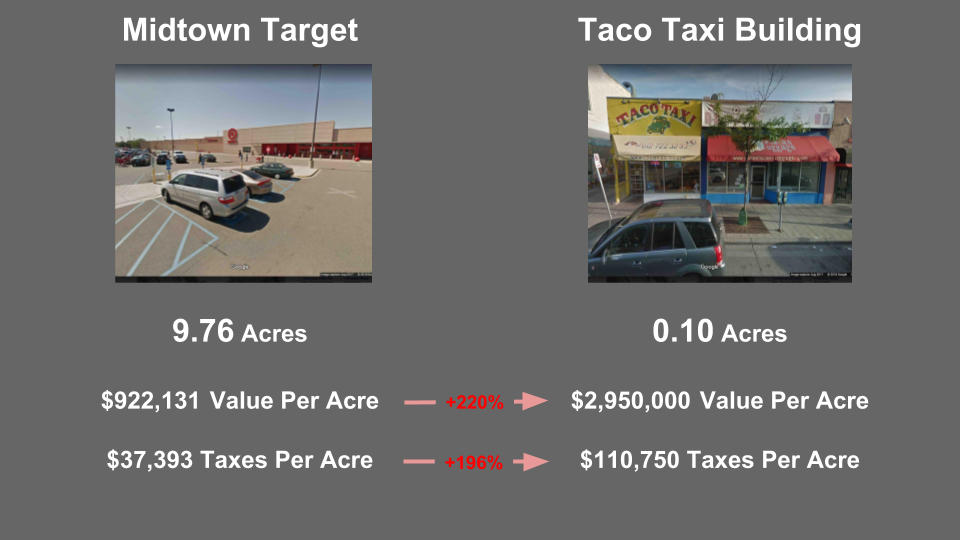
    Value per acre analysis – by Strong Towns

    To build a stronger Kingsville, I believe we can make it easier for microbusinesses to thrive by simplifying permitting processes, reducing fees, or offering small grants (or at least assist with grant writing). This doesn’t mean ignoring larger projects but recognizing that a vibrant downtown grows from many small, dynamic businesses. By lowering barriers, we can let the free market nurture our local economy from the ground up.

    So, what is Strong Towns Kingsville doing about it? We’ve started using our social media channels to inspire and educate citizens to start food related microbusinesses and events, as those leverage Kingsville’s strong restaurant and local food cultures. We are also starting a support group called “Mobile Food Mavericks” for anyone who is interested in starting or has already started a food cart, food truck, farmstand, or front yard food business.
    I’d like to hear your thoughts—whether you’re a business owner, a citizen, a Councilor, or Town staff. If my observations don’t align with yours or if you have ideas for supporting our small businesses, please comment or join the conversation at our next Strong Towns Kingsville gathering on August 21st at 6:00pm at La Dulce Vida Café, 15 Division St. S.

    Together, we will ensure our downtown remains the engine of our local economy and the heart of our community.

    Thank you for your commitment to a stronger Kingsville.

    Chad Nantais
    Local Leader – Strong Towns Kingsville

  • Growing from Within: Why Economic Gardening Beats Hunting

    Growing from Within: Why Economic Gardening Beats Hunting

    North America is in the midst of a grassroots revolution, and Kingsville can get on board or join the have-nots.

    As Strong Towns’ founder Charles Marohn explains, top-down approaches often prove rigid and ineffective, while bottom-up strategies encourage intelligent, complex, and truly adaptive growth.

    Institutional Failure

    This is what Dee Hock, the founder of VISA, observed about top-down approaches:

    “Command and control organizations are increasingly unable to achieve the purpose for which they were created. The very nature of these organizations alienates and disheartens the people caught up in them. They are increasingly unable to manage even their own affairs. We are experiencing a global epidemic of institutional failure that knows no bounds.”

    This insight hits home when we look at how our longstanding approach to local economics has left our municipalites running an endless loop of the Growth Ponzi scheme—essentially helpless to create significant quality of life gains for citizens. Just look at how Windsor and Essex County lead in all the wrong categories: poor physical and mental health, food insecurity, crime, bankruptcy, unemployment.

    International Trade Risks

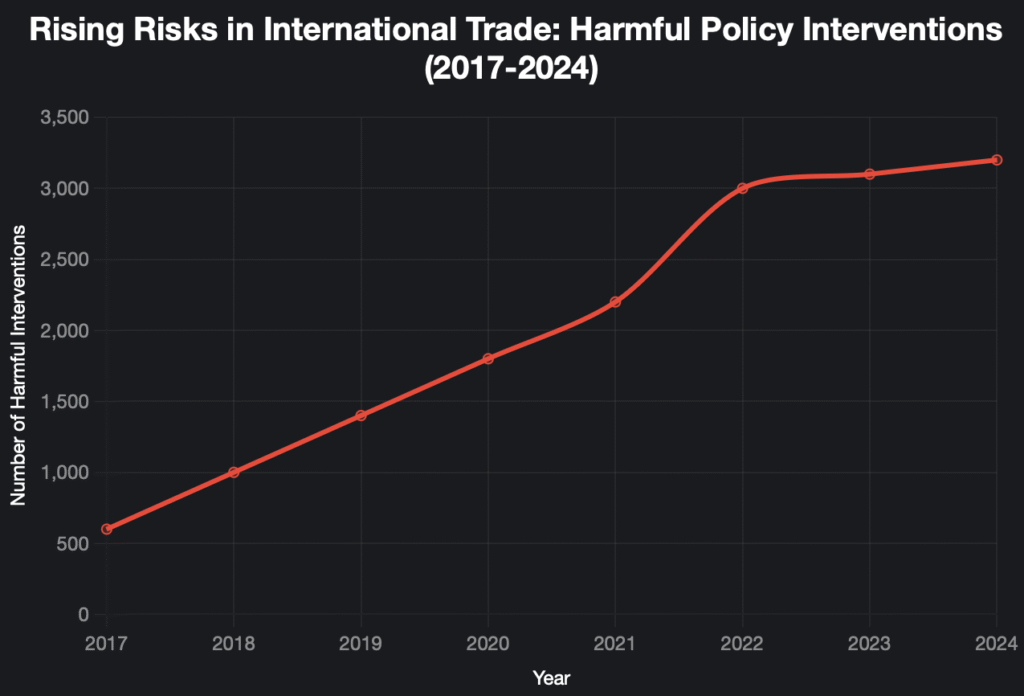
    Yet we still keep dreaming up schemes that expose us to the wild uncertainties of international trade, with all its geopolitical tensions, supply chain disruptions, and economic fluctuations that we can’t control.

    From the Global Trade Alert via the World Economic Forum’s Global Risks Report 2025

    More Money Out Than In

    The key to a resilient local economy is not rocket science: ensure that more money is coming into our community than is going out. But in reality, we’re sabotaging this balance every day—whether by ordering products from online giants like Amazon, which siphons our dollars away, or by watching local governments chase after big corporations with generous tax incentives. Those companies often extract profits and ship them elsewhere, while their global commodities force our workforce into a relentless race to the bottom, undervaluing our people’s skills and potential.

    And as you can see from all the vacant storefronts in Kingsville, the challenges are even more acute: commercial leases have drifted far from our economic reality, making it nearly impossible for aspiring small business owners to get started amid high rates and inflexible terms. These barriers are stifling the very innovation we need.

    The Path to Prosperity

    Legendary Harvard Business Professor Clayton Christensen provided a roadmap for overcoming this: the real way to lift communities to prosperity isn’t through top-down subsidies or handouts, but by creating the right conditions for market-creating innovations—ideas born from locals to solve local problems, generating sustainable wealth that stays right here.

    This principle of locals solving local needs is what lifted several nations out of corruption and poverty to become economic superpowers. Examples include: South Korea, Singapore, and even the United States in the early part of the 20th Century.

    Economic Gardening

    This leads us to Chris Gibbons’ concept of “Economic Gardening,” which stands in stark contrast to the outdated “Economic Hunting” model, as detailed in this insightful Strong Towns blog post.

    Economic Hunting involves aggressively recruiting outside companies through a cutthroat competition of subsidies and incentives—it’s like going after big game, exciting in the moment but often yielding unreliable results with no guarantee of new jobs or long-term benefits. And in many cases, these mega-deals involve so many layers of dealmaking wrapped in NDAs that financial transparency goes out the window.

    Economic Gardening, on the other hand, is about nurturing what’s already in our soil: investing wisely in local businesses, leveraging our community’s unique assets to foster organic, high-return growth. It’s proven its worth in places like Florida’s statewide program, which delivered an impressive 9:1 return on every dollar invested.

    This approach is core to building a robust local economy and embodies the Strong Towns principle of focusing on neighborhoods and incremental improvements rather than chasing silver-bullet projects. Granted, a kiosk that sells iPhone cases, or a shawarma stand may not be as glamorous as a ground-breaking photo op for a 100-acre facility, but get enough of these small businesses going, and you have a resilient economic base without putting all your eggs in one basket.

    Economic gardening has endured for millennia worldwide, outlasting the top-down schemes of our modern age. From ancient Mesopotamian markets to medieval European guilds, this bottom-up approach can’t be beat. Across Europe’s cities—Ukraine and Romania’s resilient markets, Italy’s workshops, the startup hubs of Berlin and Budapest—I saw its strength. In Belgrade, Serbia, my home for seven years, 2,300-year-old neighborhood bazaars and family businesses sustained the economy through the 44 times the city has been destroyed and rebuilt. History separates wheat from chaff: grandiose top-down projects fail, but economic gardening’s adaptive roots flourish–especially in times of chaos like the one we’re in right now.

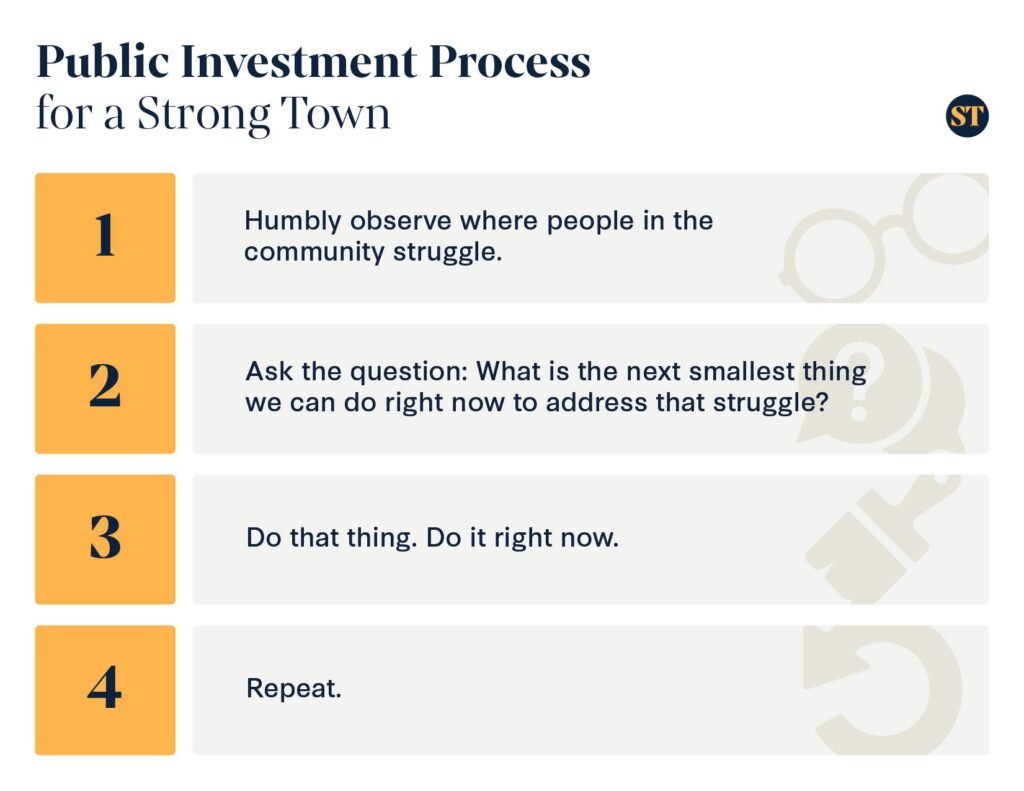
    This simple, bottom-up formula is embodied in the Strong Towns approach to public investment.

    And this same process can be applied by the municipal government, local entrepreneurs, independent local builders, neighbourhood associations, volunteer groups, and our Strong Towns group itself.

    Action Required

    If we’re serious about creating a vibrant, resilient Kingsville, we need our local government to provide the framework to unleash the untapped creativity and innovative energy within our citizens. That’s the most crucial role it can play today: empowering local entrepreneurs to thrive, instead of perpetuating the Growth Ponzi Scheme where we borrow endlessly from our future to cover yesterday’s debts. By committing to Economic Gardening, we can cultivate a prosperous future that’s truly our own.

    More than words are needed on this front. Drawing from the flexible, entrepreneur-friendly spaces you encounter throughout Europe—coworking hubs and pop-up retail spots with short-term leases and affordable rents—we’ve launched a survey to gauge interest and demand right here in Kingsville.

    If you’re an entrepreneur, remote worker, or freelancer, your feedback will help us develop these kinds of facilities to make starting a business more accessible. Please take a few minutes to fill out the survey—together, we can turn these ideas into reality.

    I’d love to hear your perspectives on all this. Feel free to reply directly or join us at our next meetup to brainstorm how we can push these changes forward in Kingsville.

    Chad Nantais
    Local Leader – Strong Towns Kingsville